G.A.I.M.A
Generative Artificial Intelligence for Micro-Tailored Adaptation to Train Context-Aware Suicide Prevention and Resilience

Role
UX/HCI Researcher
Timeline
May 2025 - August 2025
Tools
Figma, Miro, MockUp
User research, user surveys, AI research, prototyping, human factors research, etc.
Responsibilities
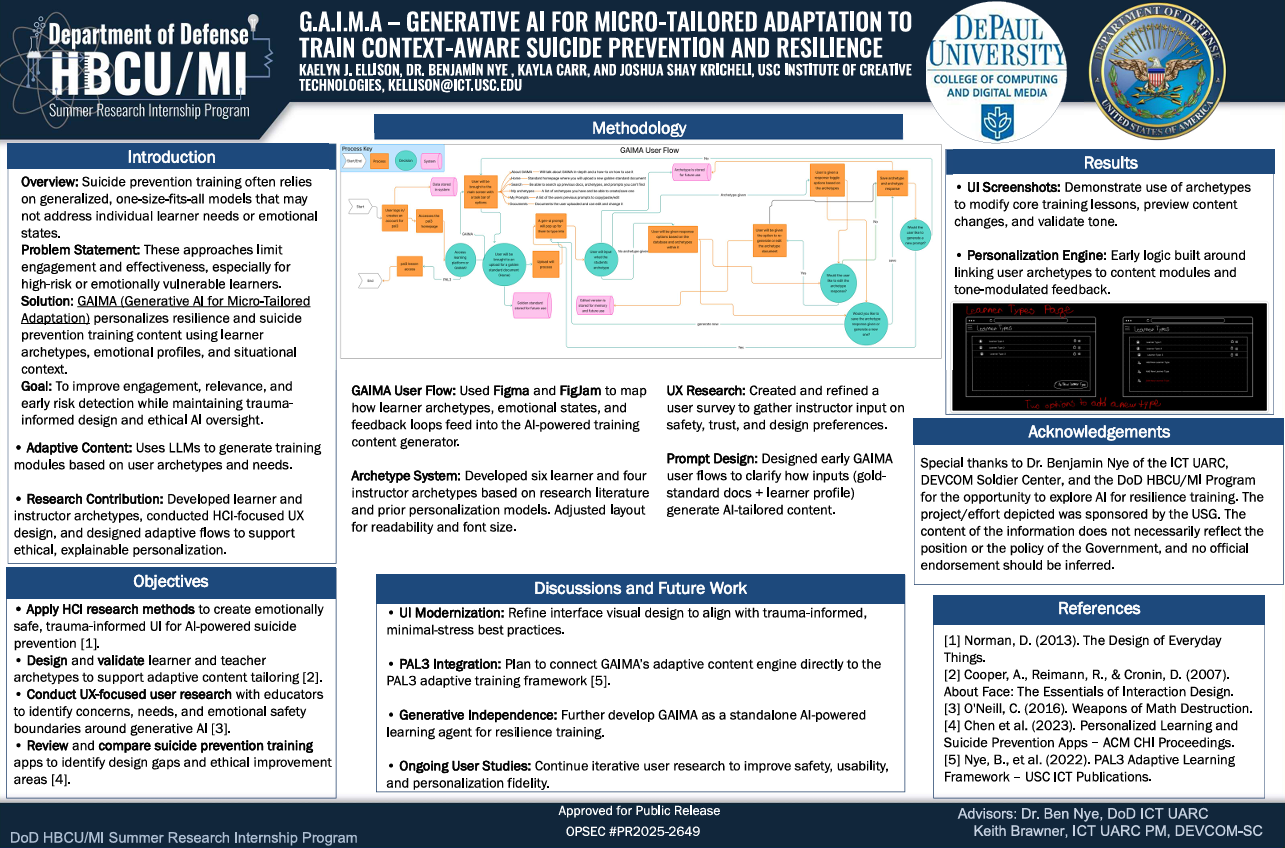
This project was completed as part of the U.S. Department of Defense HBCU/MI Summer Research Internship at the USC Institute for Creative Technologies. All details presented here focus on the design and UX research aspects of the project. Sensitive or mission-specific information has been excluded in accordance with government research guidelines.
Special Note
Overview
Suicide prevention training often relies on generalized, one-size-fits-all models that may not address individual learner needs or emotional states.
These approaches limit engagement and effectiveness, especially for high-risk or emotionally vulnerable learners.
The Problem
GAIMA (Generative AI for Micro-Tailored Adaptation) personalizes resilience and suicide prevention training content using learner archetypes, emotional profiles, and situational context.
The Product
To improve engagement, relevance, and early risk detection while maintaining trauma-informed design and ethical AI oversight.
The Goal

“Training programs that fail to account for learners’ emotional states and lived experiences risk disengagement and limited impact, underscoring the need for adaptive, personalized approaches.” — National Suicide Prevention Strategy Review, 2025
Every learner brings a different relationship to this material. Some carry lived experience with it, some are skeptical of AI touching something this personal, and some are the educators trying to hold space for both. Before I could design anything, I needed to understand who I was actually designing for, and where a one-size-fits-all training model would fail them.
Understand the User
Working alongside my mentor, Dr. Benjamin Nye, and the ICT Learning Sciences team, I mapped the landscape first: what learners and instructors actually needed, where the risk lived, and what already existed in this space.
Discovery Research
User Needs
• The ability to tailor and evaluate personalized micro-content for different learners
• Users shouldn’t feel judged or triggered when interacting with the AI
• Transparency, explainability, and a fallback to human support
• Emergency protocol for a user contemplating suicide and voicing it to the AI
• The ability to correct and improve AI outputs
First-Glance Pain Points
• A lack of suicide-prevention resources for people in the military
• Built-in systems that feel like they’re missing a human approach
• AI models that generalize one person’s response as everyone’s
• Generating inaccurate information that offends or doesn’t relate to the user
Competitive Landscape
• Talkspace — licensed live therapists and psychiatrists
• Replika — AI companion, virtual space for a “therapeutic friend”
• Headspace — meditation, stress relief, sleep resources
• Suicide Safe — gives health professionals tools to identify and assess at-risk patients
Customer Pain Points
• Users may feel uncomfortable or distrustful of an AI tool handling topics like suicide, trauma, or resilience
• Vulnerable populations worry about how their data — especially mental-health-related input — is stored, shared, or analyzed
• Generic or insensitive AI-generated content that doesn’t reflect users’ cultural, community, or trauma-informed context
• Cognitive overload and emotional triggers
Constraints
• Must escalate situations of a crisis
• User consent for data collection
• Web-app design focus
• Prompt sensitivity: AI responses must change tone and content based on the user’s archetype, emotional state, or prior behaviors meaning the system needs dynamic prompt logic and moderation layers
Business Goals and KPIs
Business Goals: AI micro-tailoring using large language models to adapt human-created “gold standard” content and present it systematically; modeling the user’s situation, context, and history; a human-centered approach that can apply the model across different personalities and archetypes.
KPIs: Session completion rate, average session duration, returning-user rate, response appropriateness, context-aware adaptation, pre/post resilience score, behavior change.
Instructor and Learner Archetypes
From the discovery research, I built two sets of archetypes in Figma and FigJam. One for the instructors relying on GAIMA to support their students, and one for the learners GAIMA is training. Four instructor archetypes and six learner personas, each grounded in a different relationship to stress, trust, and disclosure.
Instructor Archetypes
The Protective Mentor
Focused on student well-being and deeply invested in creating a safe classroom space.
Needs: Alerts for struggling students, ability to refer to support, trauma-informed guidance
AI Tone: Collaborative, caring, insightful
Design Tips: Student emotional summaries, conversation-starter tips, mental health resources for educators

The Mission-Driven Professional
High achiever under chronic stress or burnout risk. May not consider themselves in “crisis” but lacks resilience tools.
Needs: Resilience coaching, performance framing, self-regulation tips
AI Tone: Constructive, motivating, growth-based (“Let’s reframe how you respond to pressure.”)
Design Tips: Cognitive-behavioral tools, stress dashboards, goal-setting features
The Burnt-Out Educator
Passionate but overwhelmed, especially post-COVID. May feel like they don’t have time for “another tool.”
Needs: Time-saving tools, auto-generated insights, mental health support for themselves
AI Tone: Supportive, low-effort, appreciative
Design Tips: “Quick glance” dashboards, suggested talking points, self-care prompts for teachers
The Data-Driven Instructor
Wants to measure impact and see real change in student behavior or engagement.
Needs: Clear metrics, trends, engagement data
AI Tone: Concise, analytical, action-oriented
Design Tips: Dashboards with usage stats, aggregated mood trends, exportable reports
Learner Personas
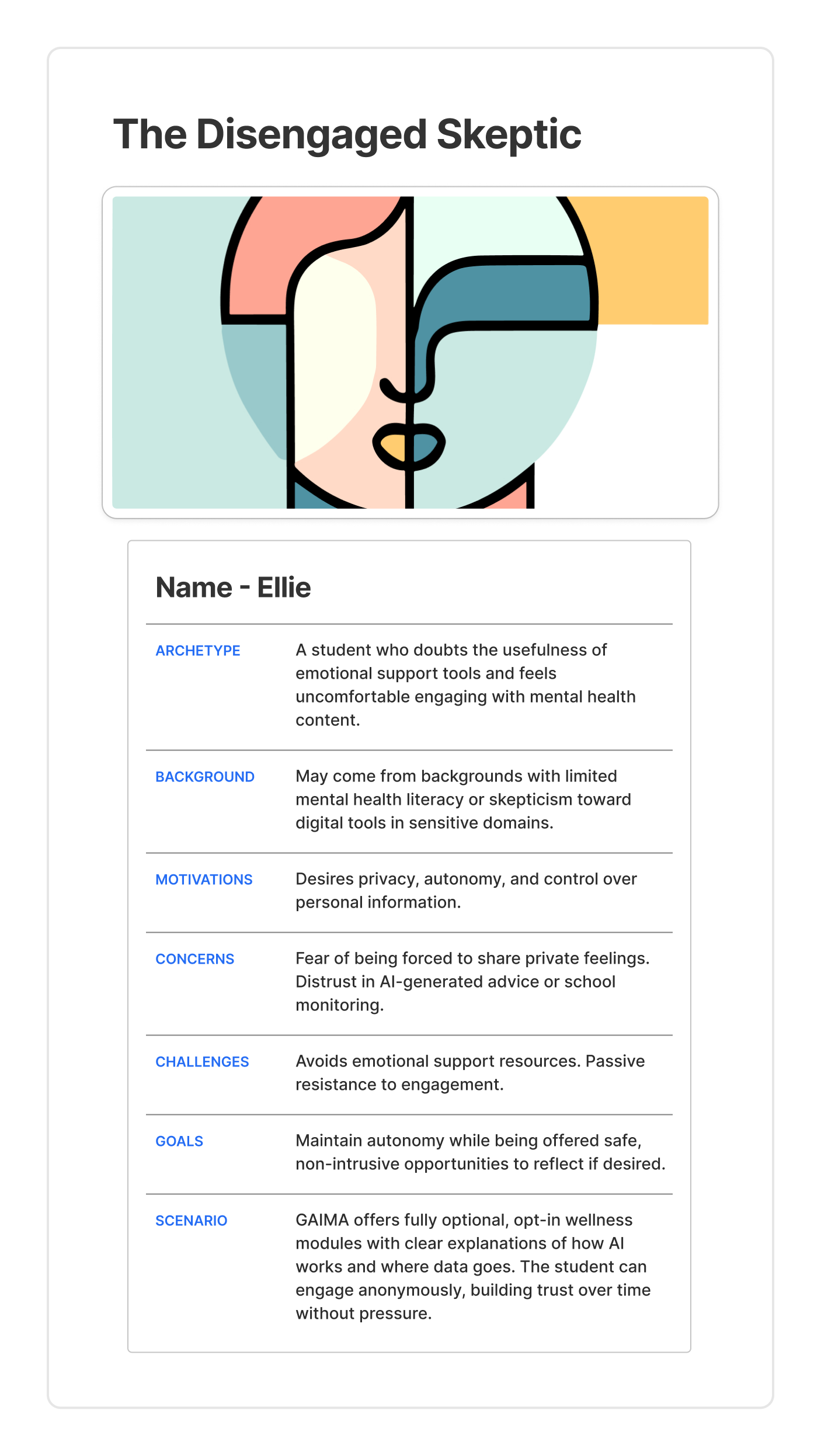
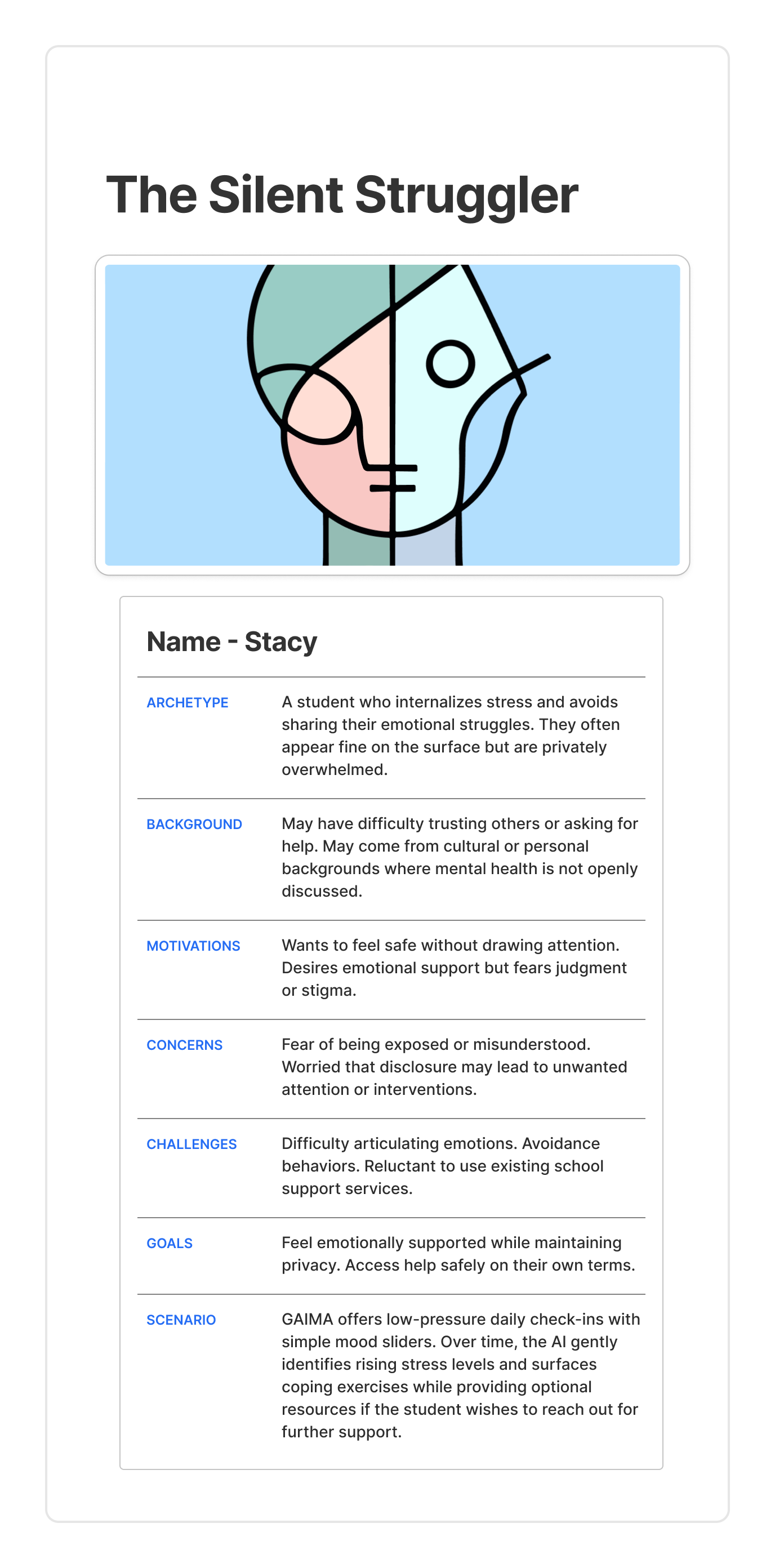
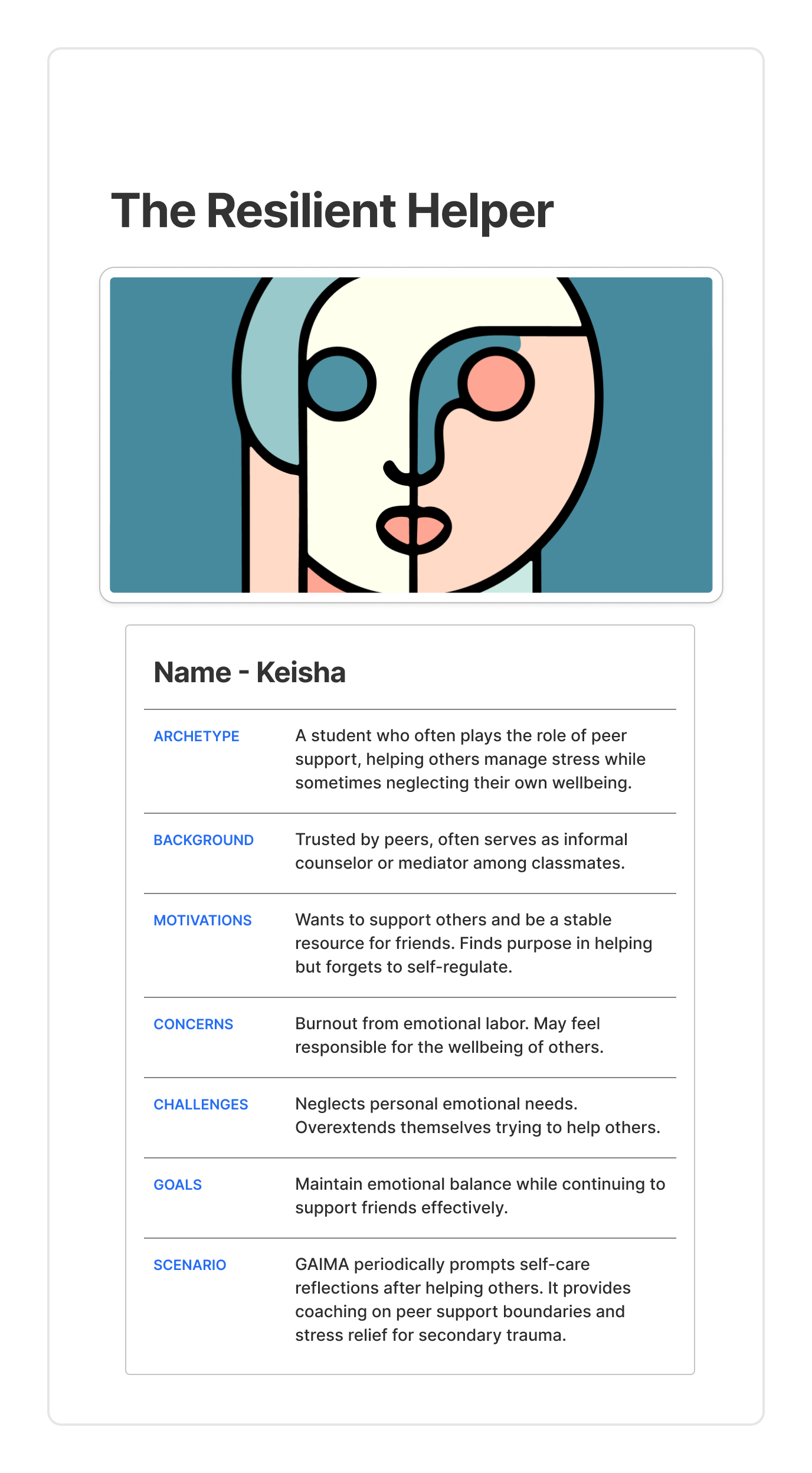
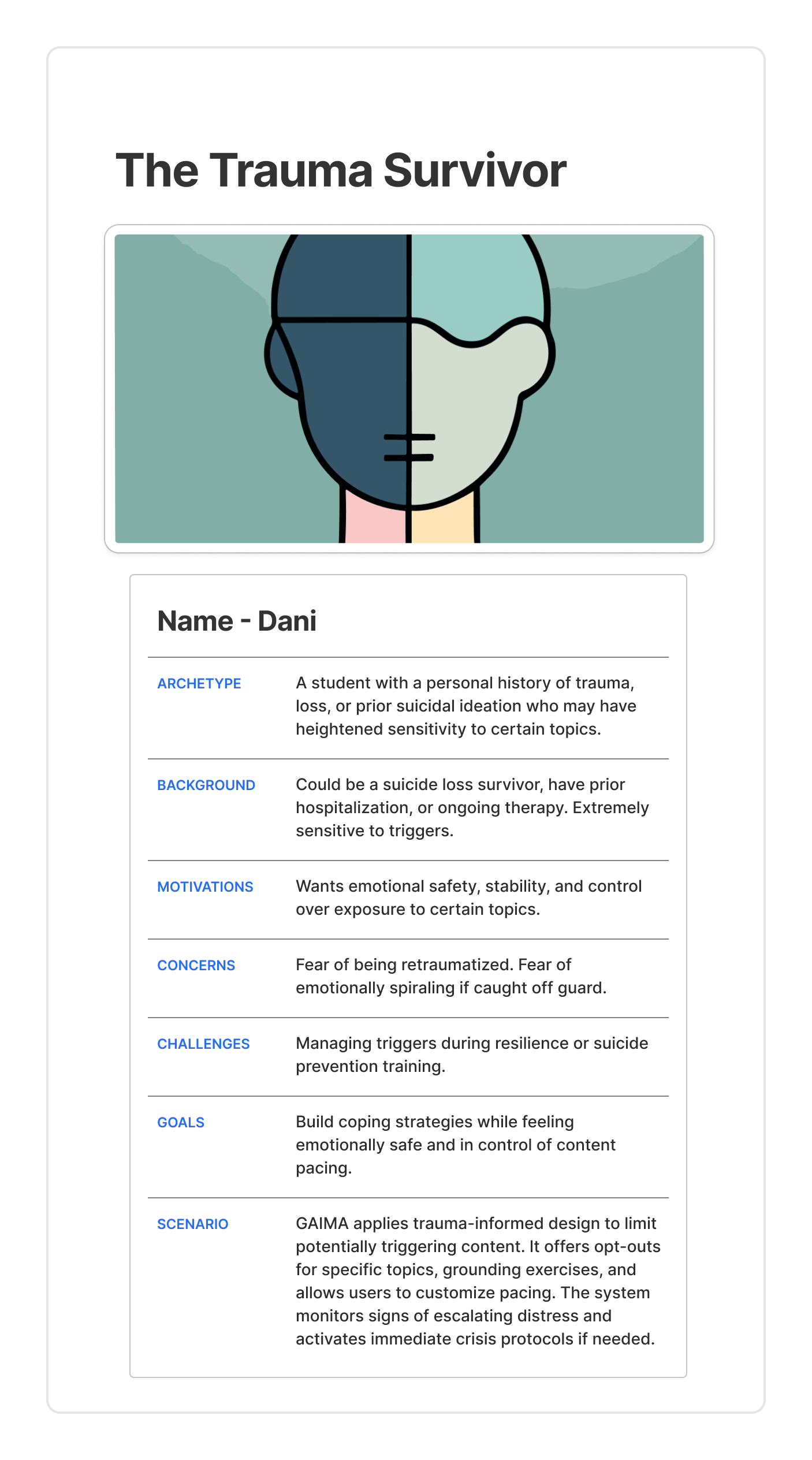
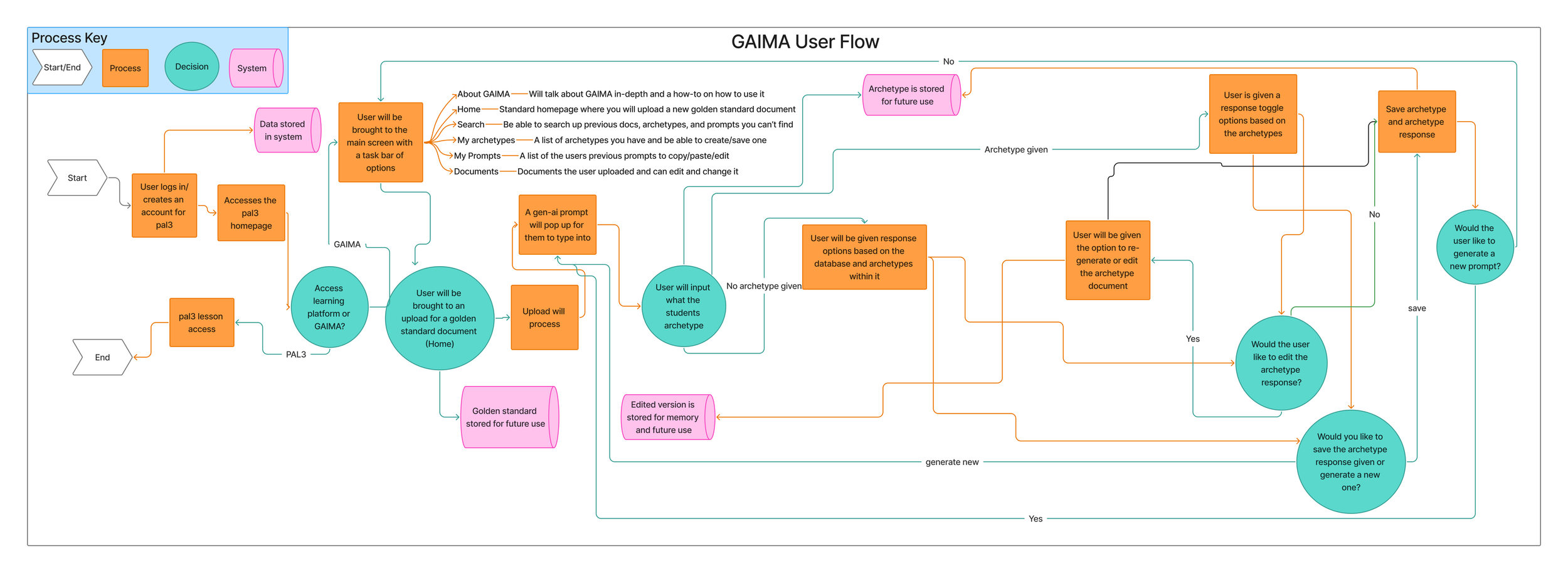
With the archetypes defined, I mapped how an instructor moves through GAIMA end to end. From logging in, to uploading a “gold standard” lesson document, to generating and refining AI-tailored content for a specific learner archetype.
Mapping the Experience
1
Log in and land on a task bar with Home, Search, My Archetypes, My Prompts, and Documents.
Upload the “golden standard” document which is the base lesson content GAIMA will adapt.
2
Prompt GAIMA; if no archetype is selected yet, it asks the instructor to choose or create one first.
3
Once an archetype is applied, GAIMA returns response options built around that archetype’s tone and needs.
4
Edit, regenerate, or save the response with every edited version is stored for future reuse.
5
Loop back and generate a new version for a different archetype, building a library of tailored content instead of one generic script.
6
From Sketch to Screen
I moved from rough sketches into wireframes and then into a working Figma interface, iterating the login flow, the goals dashboard, the learner-type editor, and the characteristics list that powers each archetype.
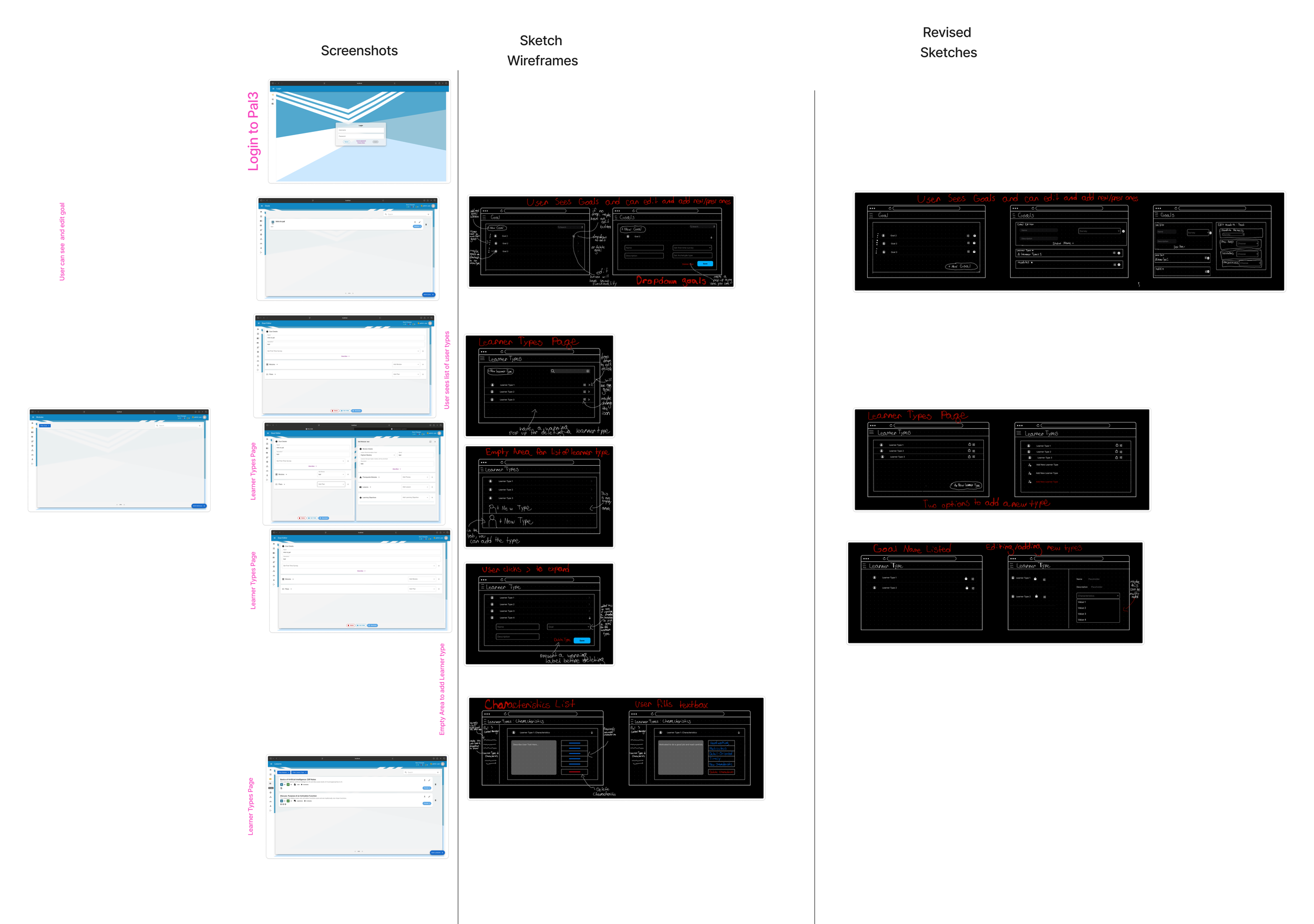
Screenshots → sketch wireframes → revised sketches
From there I built the high-fidelity flows an instructor would actually use day to day: signing in, setting goals, editing a lesson, managing learner types and their characteristics, and — at the center of it — a generation wizard that produces a new version of a lesson tailored to a selected learner type.
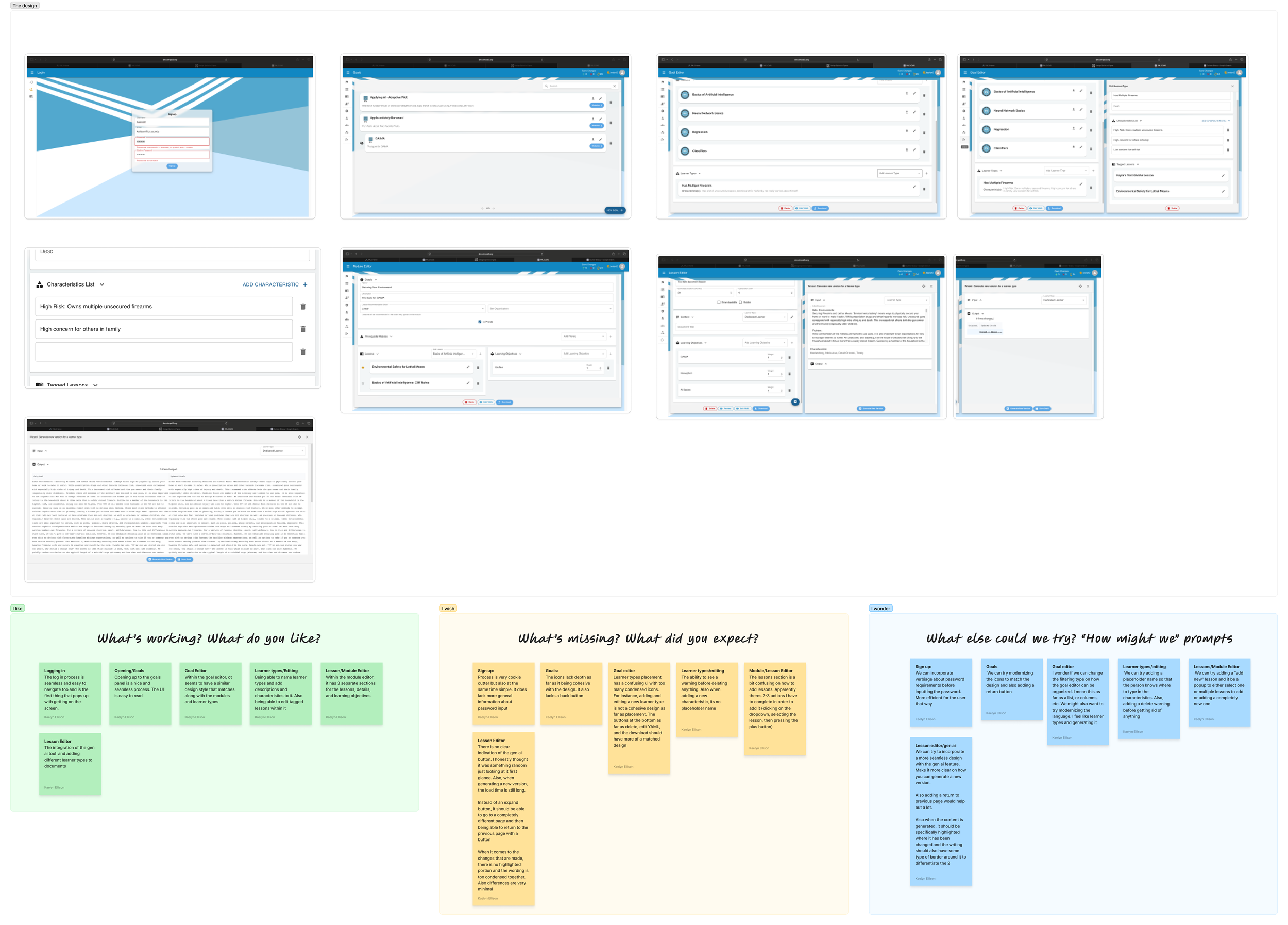
High-fidelity UI — login, goals, editors, and the generation wizard
Usability Testing and QA Feedback
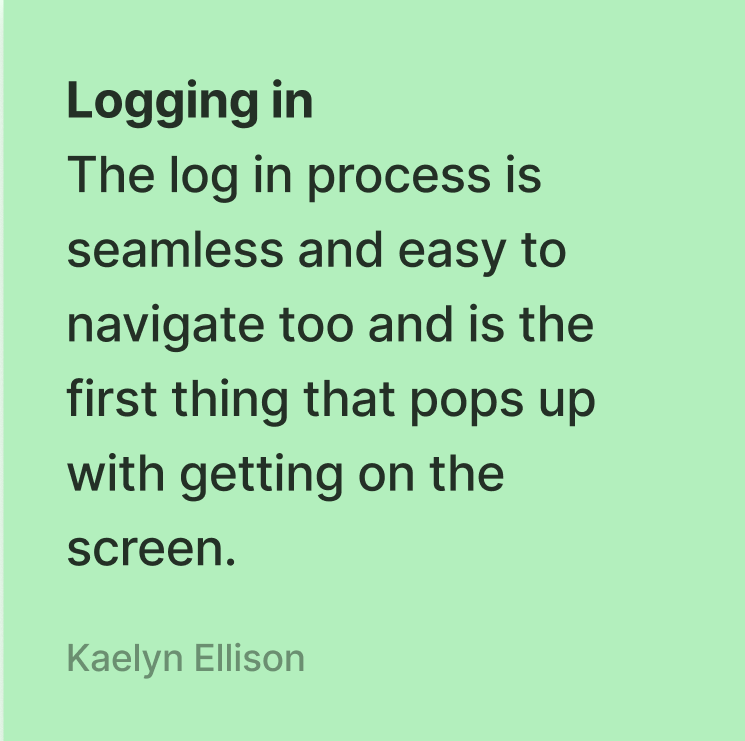
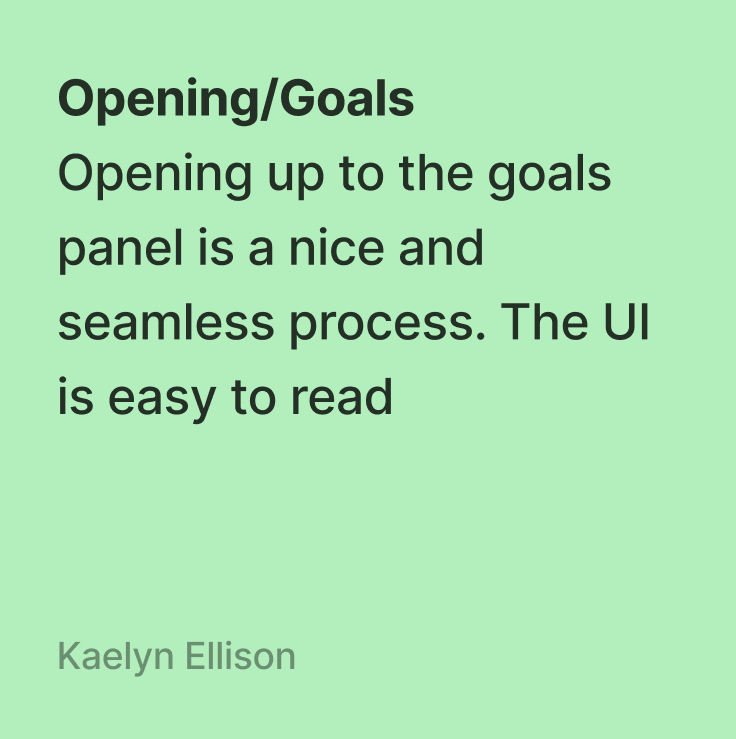
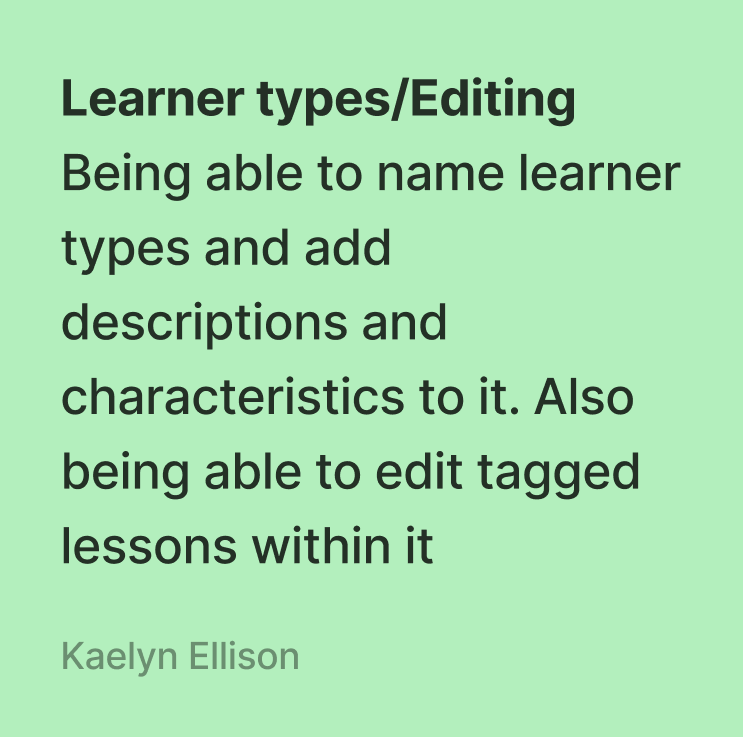
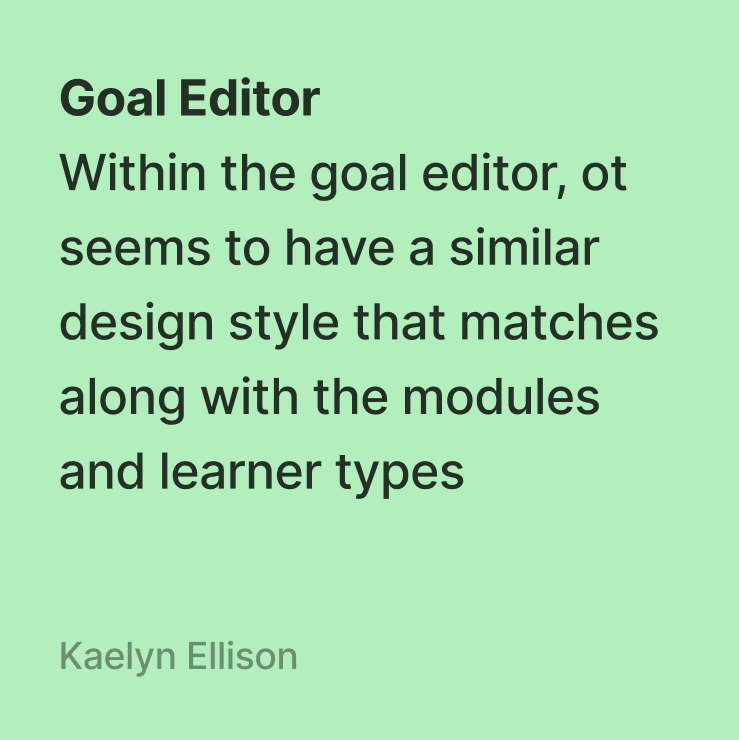
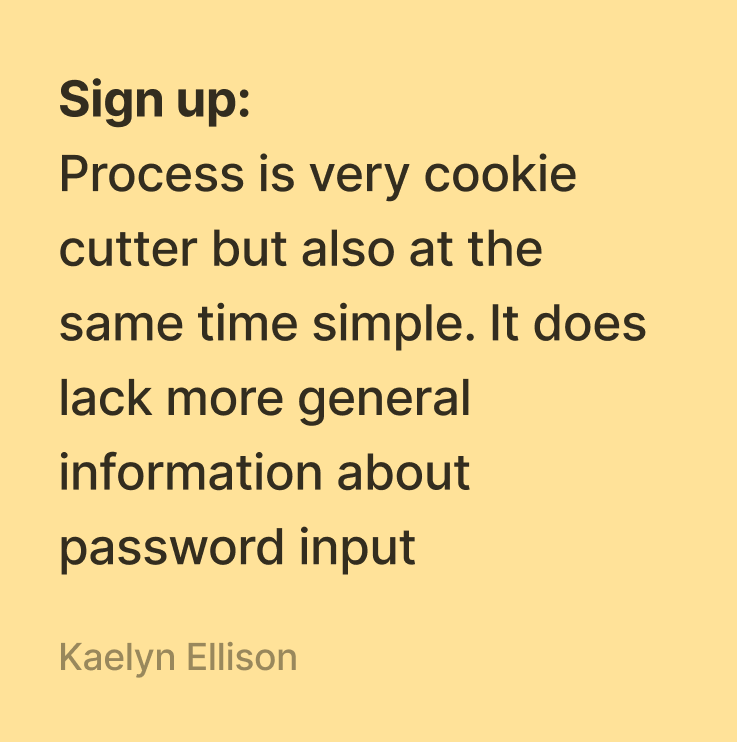
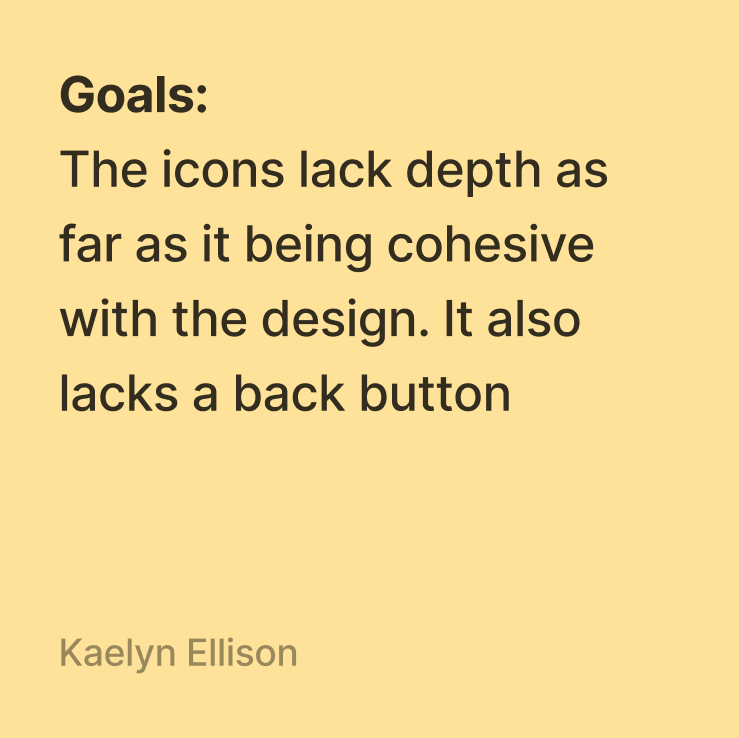
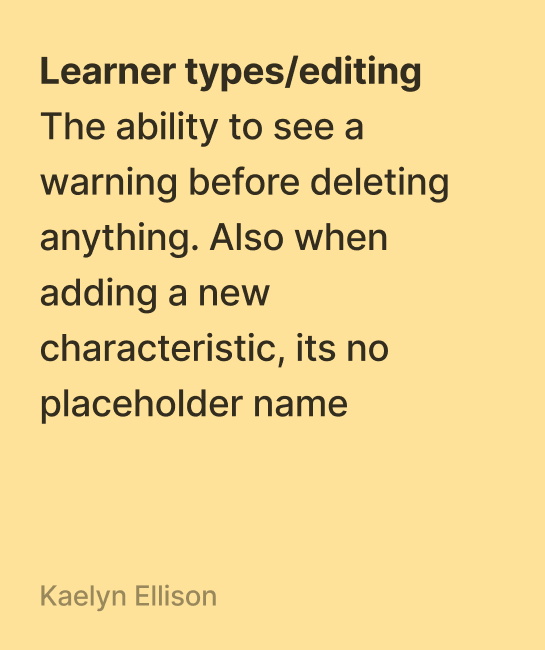
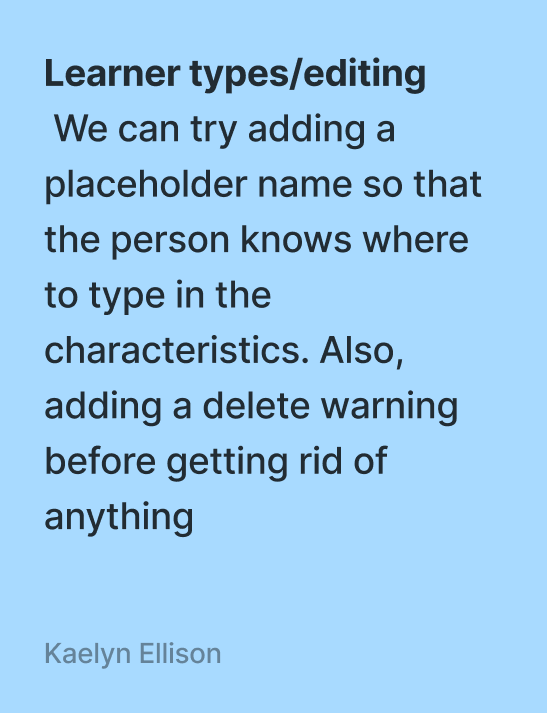
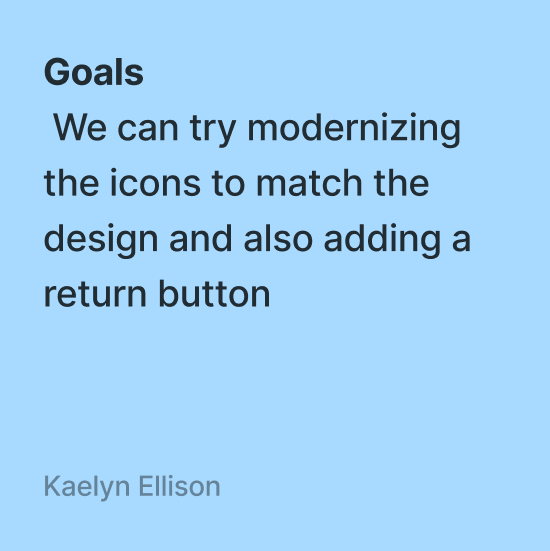
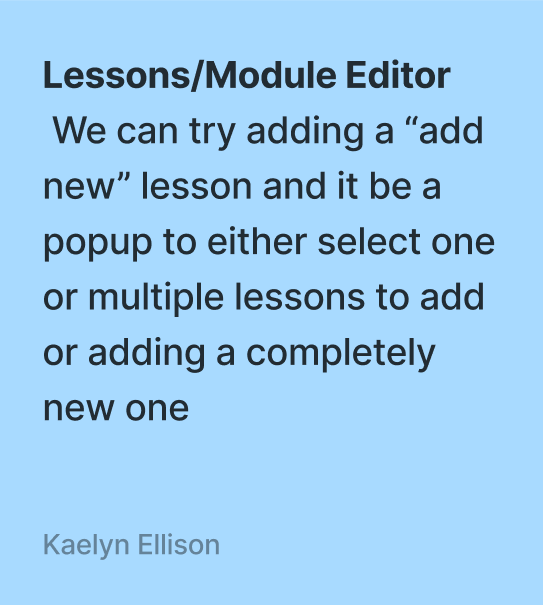
I ran the high-fidelity flows through an "I Like / I Wish / I Wonder" review to catch what was working before this went further, and what still needed rethinking.
I like…
I wish…
I wonder…

Results
UI Screenshots
Early screens demonstrate the core loop: modify training lessons, preview content changes, and validate tone before publishing to a learner.
Personalization Engine
Early prompt logic links each learner archetype directly to tone-modulated feedback — the same lesson reads differently depending on who it's for.

Discussion & Future Work
UI Modernization — refine the interface to align with trauma-informed, minimal-stress best practices.
PAL3 Integration — connect GAIMA's adaptive content engine to the PAL3 adaptive training framework.
Generative Independence — develop GAIMA further as a standalone AI-powered learning agent.
Ongoing User Studies — continue iterative research to improve safety, usability, and personalization fidelity.
Impact and Takeaway
"Design is not just about making things work — it's about making them matter."
Working on GAIMA under the mentorship of Dr. Benjamin Nye gave me a firsthand look at how AI can enhance cognitive readiness, adapt to user emotion, and ultimately extend — not replace — human capability. It's also where I learned what trauma-informed design actually demands in practice: archetypes that hold real nuance, prompts that carry safety logic, and a constant check on whether a system built to help someone in crisis could ever, even accidentally, make things worse.
Personalization only works when it's built on real listening first — the discovery research shaped every archetype and prompt decision that followed.
In a high-stakes context, the moments that matter most are safety, transparency, and an easy off-ramp to a human — not polish.
An AI tone guide is a design artifact, not just a writing exercise — every archetype needed its own voice, tested rather than assumed.
What I Learned
Refine the interface around minimal-stress, trauma-informed patterns.
Integrate GAIMA's content engine with the PAL3 adaptive training framework.
Continue usability testing as GAIMA moves toward a standalone learning agent.
Next Steps
Acknowledgements
Special thanks to Dr. Benjamin Nye, DEVCOM Soldier Center, and the DoD HBCU/MI Program for the opportunity to explore how AI can support resilience training. The project/effort depicted was sponsored by the U.S. Government; the content does not necessarily reflect the position or policy of the Government, and no official endorsement should be inferred. Approved for Public Release, OPSEC #PR2025-2649.
References
Norman, D. (2013). The Design of Everyday Things. · Cooper, A., Reimann, R., & Cronin, D. (2007). About Face: The Essentials of Interaction Design. · O'Neill, C. (2016). Weapons of Math Destruction. · Chen, A. et al. (2023). Personalized Learning and Suicide Prevention Apps, ACM CHI Proceedings. · Nye, B. et al. (2022). PAL3 Adaptive Learning Framework, USC ICT Publications.